Air fryer vs. oven: what actually changes, and when it matters
An air fryer is a small convection oven with a loud fan. Knowing that tells you exactly when to use one and when not to bother.
An air fryer does not fry. There is no oil bath and nothing is submerged. What it actually is: a small convection oven with a powerful fan and a basket that lets hot air hit food from every side at once. Once you understand that, every difference between the two appliances follows logically.
Why the fan matters so much
Food sitting in still air builds up a thin layer of cooler, moisture-saturated air around itself, sometimes called the boundary layer. That layer insulates the food and slows both browning and drying.
A fan strips that layer away and keeps replacing it with fresh hot air. The result is faster heat transfer and, crucially, faster moisture removal from the surface — which is precisely what crisping is.
A conventional oven has a fan too, if it is a fan oven. The air fryer's advantage is not that it has one, but that it is small. A tiny chamber means the air changes over many times a second and the appliance recovers its temperature almost instantly when you open it. That is the whole story.
What the air fryer genuinely does better
Crisping without deep frying. A breaded chicken fillet brushed with a little oil comes out genuinely crunchy for a fraction of the fat of deep frying. This is the use case the appliance was built for and it delivers.
Speed on small batches. Almost no preheat, and cooking times typically 20 to 25 percent shorter than the same item in an oven.
Reheating anything that should be crisp. This is the underrated one. Leftover pizza, chips, samosas, spring rolls, yesterday's roast potatoes — a microwave makes all of these soggy because it heats the water inside them. An air fryer drives moisture off the surface and they come back genuinely crisp. Many people end up using it more for this than for cooking.
Energy. Heating a small box uses far less power than heating a large one, which matters if you are cooking for one or two.
What the oven does better
Anything with a wet batter. The fan will blow it around before it sets. Cake batter, Yorkshire puddings, anything loose — use the oven.
Volume. Air fryer baskets are small, and the moment you crowd one you have destroyed the only advantage it has. Piled-up food blocks the airflow, and you get steamed, pale results — the same failure mode as an overcrowded frying pan.
Delicate bakes. The direct blast can dry out or over-brown the surface of a soft cake before the middle is done.
Large or dense items. A whole chicken or a big tray bake needs the steadier, gentler environment of a full-size oven.
Converting an oven recipe
The standard conversion, and it is reliable:
- Drop the temperature by about 20 °C (roughly 25 °F)
- Cut the time by about 20 percent
- Check early, then keep checking
So a recipe asking for 200 °C for 20 minutes becomes roughly 180 °C for 16 minutes in the air fryer.
Treat that as a starting point, not a rule. Air fryer models vary far more than ovens do — basket shape, fan speed and wattage all differ — and the same setting in two machines can behave quite differently. Shake or turn halfway through; it is the equivalent of stirring, and it stops the underside going pale.
Is air-fried food actually healthier?
Compared with deep frying, clearly yes: you are using a spoonful of oil instead of a litre, and far less of it ends up in the food.
Compared with oven baking, the honest answer is barely. Both use similar small amounts of oil. If you are switching from an oven to an air fryer expecting a health improvement, the gain is speed and texture, not nutrition.
Getting better results
Do not overcrowd. One layer, pieces not touching. This is the single rule that matters most.
Use a little oil. Entirely dry food browns unevenly and can go leathery. A brush or light spray is enough.
Pat food dry first. Same principle as searing — surface moisture has to leave before browning can start.
Preheat for two or three minutes when you want a crisp exterior. Not always necessary, but it helps.
Do not use aerosol sprays in a non-stick basket. The propellants and additives in many cooking sprays build up and degrade non-stick coatings over time. A refillable pump bottle with your own oil avoids the problem.
Watching beats reading for this one — subscribe on YouTube for a new recipe every few days.
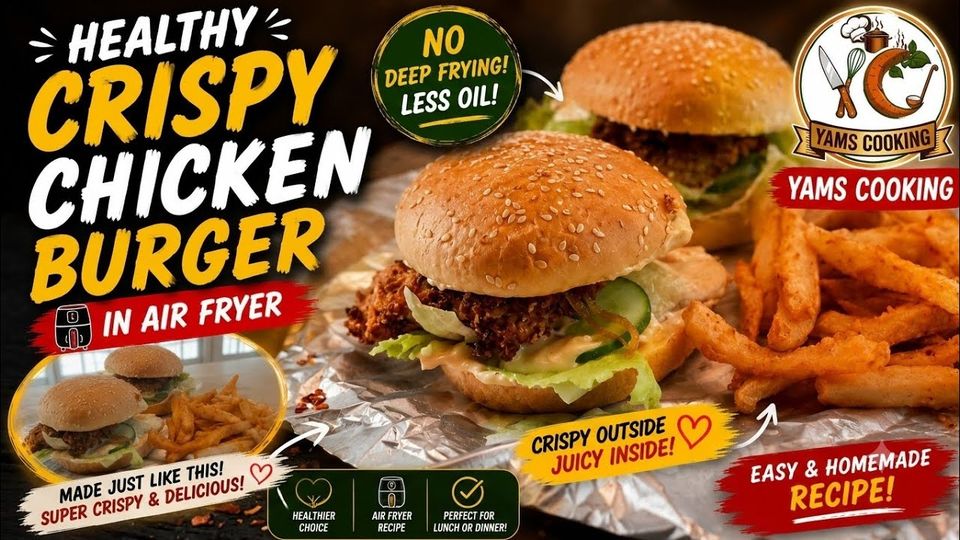
Make itCrispy Chicken Burger in the Air FryerFull recipe with measurements →
Common questions
Do I need to change the temperature when using an air fryer?
Yes. Drop the oven temperature by about 20 °C and cut the cooking time by roughly 20 percent, then check early. A recipe calling for 200 °C for 20 minutes becomes about 180 °C for 16 minutes.
Is an air fryer just a small convection oven?
Essentially, yes. The difference is size: a small chamber means the air circulates many times faster and the temperature recovers almost instantly, which is why it crisps better and faster than a full-size oven.
Is air-fried food healthier than oven-baked food?
Barely. Both use similar small amounts of oil. Air frying is much healthier than deep frying, but compared with oven baking the real gains are speed and texture rather than nutrition.
Why is my air fryer food soggy instead of crisp?
Almost always overcrowding. Piled-up food blocks the airflow that does the crisping, so it steams instead. Cook in a single layer with space between pieces, pat food dry first and brush lightly with oil.