Why does my cake sink in the middle? Read the crater
A cake sinks when the gas finishes expanding before the centre sets. The shape of the dip, and when it appears, tells you which of five causes it was.
The cake rises beautifully. You can see it doming through the oven door. Then it comes out, and over the next ten minutes the middle sinks into a crater.
It is almost never bad luck and almost never the recipe. A sunken cake is a timing problem, and usefully, the shape of the dip and the moment it appears tell you which one.
What is actually going wrong
A cake rises because the raising agent produces gas and the gas expands in the heat. It stops rising and holds that shape when the structure sets: egg proteins coagulate and starch swells and gels, turning liquid batter into a solid foam.
Both happen at measurable temperatures. In sponge batters, starch gelatinises at roughly 79–88°C and egg protein coagulates at roughly 82–96°C. Sugar pushes both higher, so a sweet, rich cake may not fully set until the centre is near 100°C.
The centre reaches those temperatures last, because heat travels inward from the tin and the oven air. If the gas finishes expanding before the middle gets there, nothing is holding it up, and it falls.
Every cause below is a version of that one sentence.
1. It came out too early
The most common cause by a distance. The top browns, the edges pull away, the kitchen smells finished — and the centre is still batter held up by hot gas. It looks perfect in the oven and collapses on the rack.
The tell: the crater appears after the cake leaves the oven, usually within ten minutes, and the sunken part is damp or sticky underneath.
A skewer in the centre should come out clean. Moist crumbs mean done for brownies, not for cake — that is the single most common cross-wiring in home baking. If you have a probe thermometer, 96–99°C in the middle of a sweet cake is a far better signal than any number of minutes.
2. The oven door opened too soon
Opening the door drops the oven temperature sharply. If the structure has not set yet, the partly risen batter loses the heat it needed to finish, and the middle falls while it is still in the tin.
The tell: the cake was domed when you looked, and flat or dipped the next time — the collapse happened during baking, not after.
Leave it shut for the first three quarters of the stated time. If you need to turn the tin for an uneven oven, do it quickly and late.
3. Too much raising agent
More baking powder does not mean more lift. Past a point it produces gas faster than the structure can set around it, the cake rises dramatically, the bubbles grow too large to hold, and the whole thing deflates.
The tell: a high dome that sinks to a deep crater, often with a slightly coarse, holey crumb and a faint soapy or metallic aftertaste.
Measure it level, not heaped. And check the date: old baking powder causes the opposite problem, a cake that never rises much at all, which is easy to misread as sinking.
4. The oven runs hot
Too hot and the outside sets long before the inside has finished rising. You get a peaked, cracked top over an underset middle, and it caves as it cools.
The tell: a dark, domed, cracked crust with a dense or damp centre — the cake looks overbaked and underbaked at once.
Domestic ovens are routinely 10–20°C out. An oven thermometer costs very little and settles the question permanently.
5. Overmixing, or the wrong tin
Beating too long after the flour goes in whips in large, unstable bubbles that pop in the heat. Too much batter in too small a tin gives the structure more weight than it can carry before it sets.
The tell: for overmixing, large irregular holes through the crumb. For an overfilled tin, a cake that rose over the rim and then sank back inside it.
Fold flour in until the streaks just disappear, and fill a tin no more than two thirds full.
Can you save it?
If the centre is raw and the cake is still warm, it can sometimes go back in — but only if you catch it within a few minutes and the oven is still at temperature. Once it has cooled, returning it to the oven dries the outside without rescuing the middle.
Otherwise, stop fighting it. A sunken cake with a cooked centre is structurally fine and tastes the same. Cut out the dip and serve it as squares, fill the crater with ganache or whipped cream, or break it up into a trifle. The failure is cosmetic.
What you should not do is serve a cake whose centre is genuinely raw. Underbaked batter containing raw egg is a food safety question, not a texture one.
The short version
- Sank after leaving the oven — underbaked. Bake longer, test with a clean skewer.
- Sank while baking — the door opened too early, or the oven runs hot.
- Rose very high, then crashed — too much raising agent.
- Large holes in the crumb — overmixed after the flour went in.
- Never rose much at all — raising agent past its date.
If you want to sidestep the whole problem while you get your oven's measure, a cake cooked in a covered pot is far more forgiving: the steam keeps the heat gentle and even, and there is no door to open.
Watching beats reading for this one — subscribe on YouTube for a new recipe every few days.
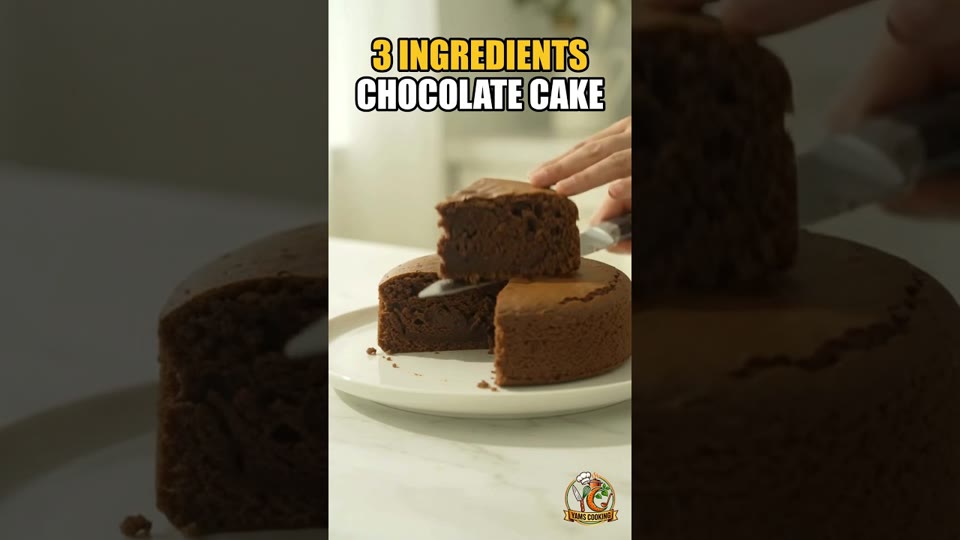
Make it3-Ingredient Chocolate CakeFull recipe with measurements →
Common questions
Why did my cake sink in the middle after baking?
Almost always because it came out before the centre set. The structure of a cake sets when egg protein coagulates and starch gelatinises, at roughly 82-96C and 79-88C respectively, and higher still in a sweet batter. If the middle has not reached that, there is nothing holding it up once the gas stops expanding, so it falls as it cools.
Can I put a sunken cake back in the oven?
Only if you catch it within a few minutes and the oven is still hot. Once the cake has cooled, the outside dries out long before the centre finishes cooking. If the centre is already cooked and it has simply dipped, leave it alone and fill or trim the crater.
Does opening the oven door really make a cake sink?
Yes, but only in a specific window. Before the structure sets, the drop in temperature can stall the rise and let the middle collapse. Once the cake is set, usually about three quarters of the way through baking, opening the door briefly does little harm.
How do I know when a cake is done without a thermometer?
A skewer in the centre should come out clean, with no wet batter and no moist crumbs. Moist crumbs mean done for brownies, not for cake. The top should spring back when pressed lightly, and the edges should have started to pull away from the tin.
Can too much baking powder make a cake sink?
Yes. Excess raising agent produces gas faster than the structure can set around it. The cake rises dramatically, the bubbles grow too large to hold their shape, and it collapses. It often leaves a coarse crumb and a faint soapy aftertaste. Measure level, never heaped.